
Field Notes
What Actually Grows Here
A planting guide for Central Texas yards — privacy, shade, fruit, and the two kinds of dirt you might own.
Updated July 2026
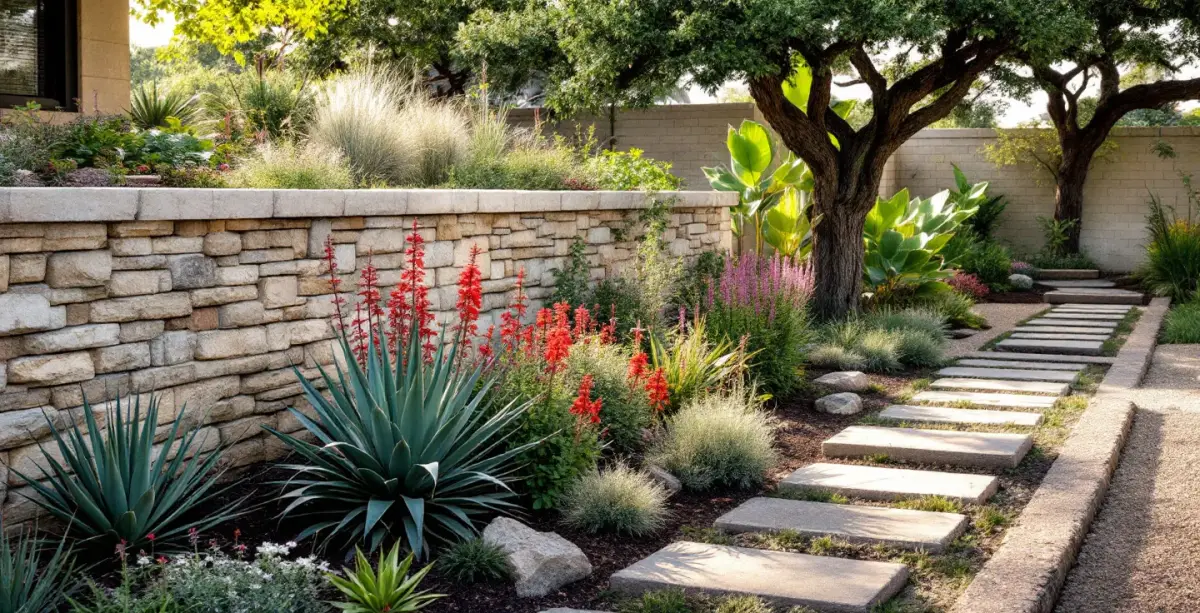
The first thing to know about gardening in Greater Austin is that “Austin” is two different places. Drive west of I-35 and you’re on the Edwards Plateau — a few inches of alkaline caliche over solid limestone, where planting a tree sometimes involves a digging bar and a bad afternoon. Drive east and you’re on blackland prairie — deep, dark clay that’s rich but swells when wet and cracks wide open in August. Most planting advice fails here because it doesn’t ask which side of that line you live on. So ask it first, then plant accordingly.
The west side: caliche, limestone, and deer
If you’re in Westlake, Bee Cave, Dripping Springs, Steiner Ranch, or anywhere the ground rings when a shovel hits it, you’re gardening on the Edwards Plateau. Two rules run everything: soil is shallow and alkaline, and the deer consider your landscaping a buffet.
What thrives: live oak, cedar elm, Texas mountain laurel, Texas redbud, possumhaw, evergreen sumac, agarita, cenizo (Texas sage), salvias, rosemary, lantana, blackfoot daisy, and nearly any agave or yucca. These are the plants the Hill Country was already growing before anyone owned it.
Deer reality: deer pressure west of Loop 360 is heavy enough that “deer-resistant” should drive your plant list. Rosemary, cenizo, salvia, lantana, and mountain laurel usually survive; roses, daylilies, and most vegetables need fencing. A common west-side pattern: a fenced kitchen garden close to the house, native and aromatic plants everywhere else.
The mistake to skip: azaleas, gardenias, and most East Texas acid-lovers. The alkaline soil locks them out of iron; they yellow and sulk no matter what you feed them.
The east side: blackland clay and big skies
In Manor, Hutto, Elgin, Taylor, and most of Pflugerville, you have what farmers spent a century fighting over: deep blackland prairie clay. Trees planted here actually get to stretch their roots — but the clay swells and shrinks with moisture, so water consistently (it protects foundations as much as plants).
What thrives: bur oak, chinkapin oak, cedar elm, Mexican plum, desert willow, vitex, crape myrtle, and almost the entire native list from the west side — they’re just faster and bigger over here. Vegetable gardens are genuinely easier: amend a bed with compost and the clay’s fertility does the rest.
Privacy screens people actually succeed with
The question every new homeowner asks by the second summer. Ranked by how often they work out:
- ‘Will Fleming’ yaupon holly — narrow, evergreen, native, unbothered by soil type. The workhorse for tight side-yards.
- Wax myrtle — fast, soft, evergreen, 10–15 feet; wants a little water on the west side.
- Nellie R. Stevens holly — the classic dense wall, 15–20 feet, handles both soils.
- Eastern red cedar / ‘Brodie’ juniper — bulletproof evergreen screening on caliche where little else volunteers.
- Italian cypress — the formal look; fine in well-drained west-side spots, unhappy with clay-wet feet on the east side.
- Skip running bamboo. It screens fast and then becomes your neighbor’s problem and your deed-restriction violation. Clumping varieties exist, but read the tag twice.
Fruit that earns its water
Central Texas fruit is a real thing — pick varieties bred for our chill hours (roughly 500–700, verify per variety):
- Fig — the region’s easiest fruit tree; ‘Celeste’ and ‘Brown Turkey’ shrug off both soils.
- Pomegranate — loves the heat, handles alkaline soil, ignores drought once established.
- Peach — the Hill Country classic (‘La Feliciana’, ‘June Gold’); needs well-drained ground, so west-siders should plant high or in berms.
- Loquat — evergreen, ornamental, and the fruit beats anything at the store; occasional hard freezes cost you a crop, not the tree.
- Meyer lemon / satsuma — in pots you can wheel into the garage on the five nights a year that matter. In-ground citrus is a gamble north of San Antonio.
- Pecan — the state tree, magnificent on east-side clay with room to roam; give it 40 feet and 40 years.
Two housekeeping notes locals learn the hard way
Oak wilt is real. If your street is lined with live oaks — and in half the neighborhoods we cover, it is — don’t prune oaks between February and June, and paint every cut, every time. It’s the difference between a neighborhood canopy and a row of stumps; some HOAs write it into the rules.
Watering restrictions are the default, not the exception. Most area utilities run one-or-two-day-a-week schedules every summer. Native and adapted plantings aren’t a compromise here — they’re the strategy that looks good in September when everything else has given up.
A good local nursery will steer you better than any list — the independent growers around Austin stock for this climate specifically, and their staff will talk you out of mistakes the big boxes will happily sell you. Verify varieties and current watering rules for your specific address; if you want to know what the yards actually look like street by street, that’s what our neighborhood guides are for.
The guides go street by street.
Every neighborhood we cover gets the same honest treatment — schools, taxes, tradeoffs, and the local's list.
Browse the guides